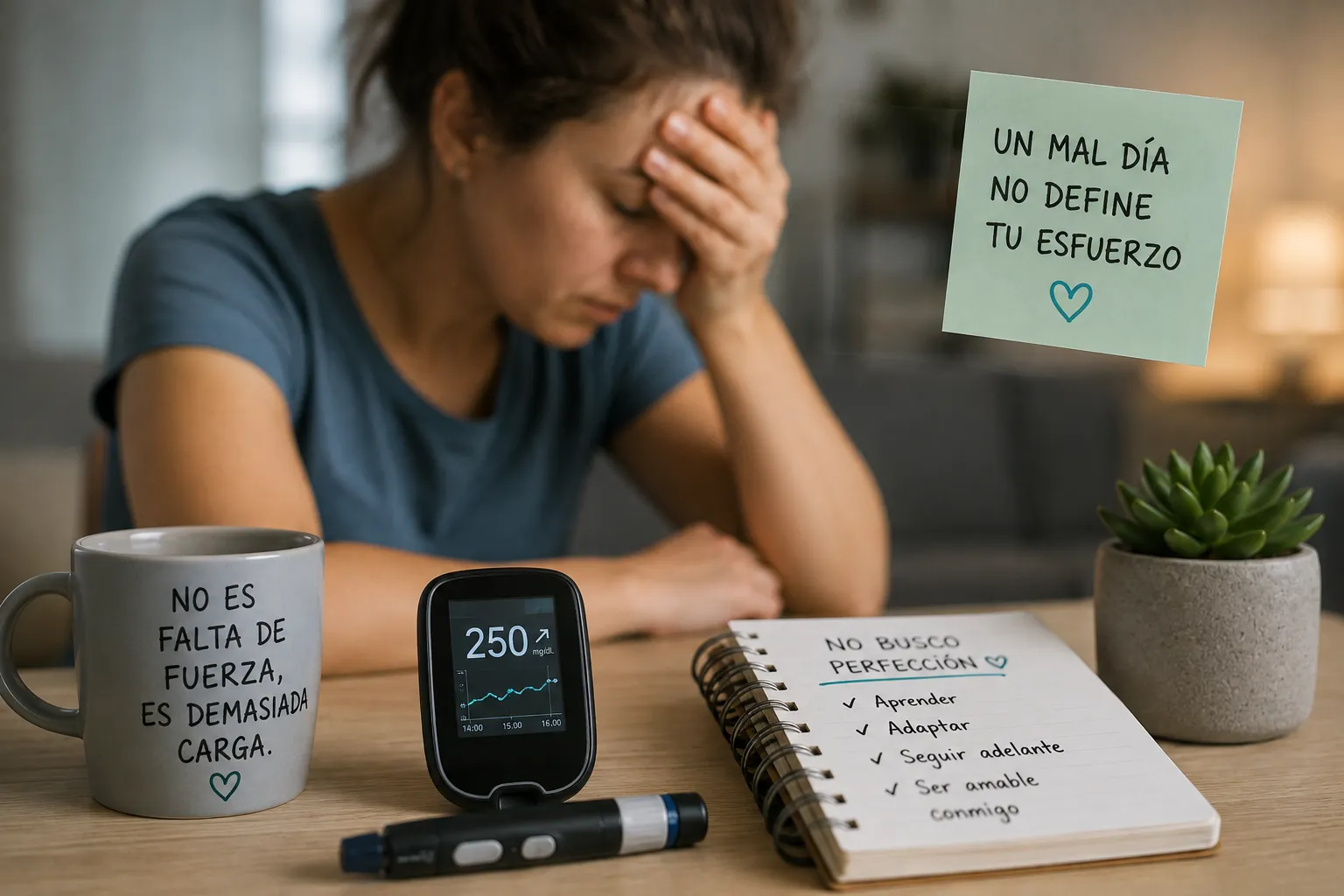
There's one part of living with diabetes that I think we talk about a lot less than we should: guilt. It does not appear in the analytics, it is not measured by the sensor and it is not reflected in the time in range, but it can accompany us for years.
I think many of us have experienced that situation at some point. You look at the sensor and see a 250 with an up arrow. Almost automatically you begin to reconstruct the last few hours. Maybe you miscalculated your carbohydrates, you took your insulin too late, you ate more than planned, or you simply have no idea what happened. And then that question we know all too well appears: "What have I done wrong?"
The funny thing is that we rarely ask ourselves simply "what happened?" It seems the same, but it is not. The first question looks for a culprit and almost always that culprit is us. The second tries to understand a piece of information to decide what to do.
After many years living with diabetes I have learned that you can do the exact same thing on two different days and get completely different results. You can eat the same thing, calculate the same carbohydrates and take the same amount of insulin, and one day have a perfect graph and the next find yourself with hyperglycemia that you can't explain.
Because diabetes is not a perfect equation. Stress, exercise, sleep, hormones, illness, insulin absorption, or even what we did several hours earlier can completely change the outcome.
However, we still feel that each issue is a kind of exam.
And I think part of the problem is in the language that we have used for years around diabetes. We talk about "good control" and "bad control", of being "well controlled" or "uncontrolled", of having done things well or badly. Even the colors of our apps seem to reinforce that feeling: green when we're in range, red when we're out of range.
It is very easy to end up confusing our results with our behavior.
And they are not the same.
A high glucose is a fact, not a failure. Hypoglycemia also doesn't necessarily mean you've done something wrong. They are situations that we must correct and from which we can try to learn, but mentally punishing ourselves for them is not going to improve our glucose.
Guilt also appears with food. I believe that few diseases have such a complicated relationship with something as everyday as eating. We know that certain foods can complicate our control and, even so, sometimes we want to eat them. Because we are celebrating a birthday, because we are having dinner with friends or simply because we feel like it.
And then comes the graph.So it's easy to think, "I knew this was going to happen."
But living with diabetes for decades can't mean trying to behave perfectly for decades. Obviously we must take care of ourselves and reduce our risks, but we also need to find a way to live with the disease that is sustainable.
For me there is a fundamental difference between responsibility and guilt.
Responsibility is looking at a situation and asking what you can learn from it. Maybe next time you will have to advance the insulin, modify a dose, change something in the food or simply accept that you can't always control the result.
Guilt, on the other hand, does not usually teach us much. It just makes us feel like we've failed.
And there is another even more difficult guilt: the one we feel in front of the people we love. When our partner wakes up due to a sensor alarm, when our parents worry about hypoglycemia, when we have to stop a trip to take glucose or when someone has to wait while we resolve a situation related to diabetes.
In those moments we can feel that our illness also affects the lives of others. But we don't choose to have diabetes. We can take responsibility for taking the best care of ourselves, but we shouldn't feel guilty for needing help or having a bad day.
Perhaps one of the most difficult things to learn when you have had diabetes for many years is precisely to stop chasing perfection.
We don't need a perfect graph every day. We need to make thousands and thousands of decisions throughout our lives and make that effort sustainable.
Now, when a number appears that I wasn't expecting, I try to change the question.
Instead of thinking "what did I do wrong?", I try to think "what happened and what can I do now?"It seems like a small change, but it completely changes the way you deal with diabetes.Because we already have enough work trying to control our glucose without also carrying the guilt of not being able to do it perfectly.
Do you also blame yourself when your diabetes doesn't turn out as you expected?
What situations generate that feeling for you the most?