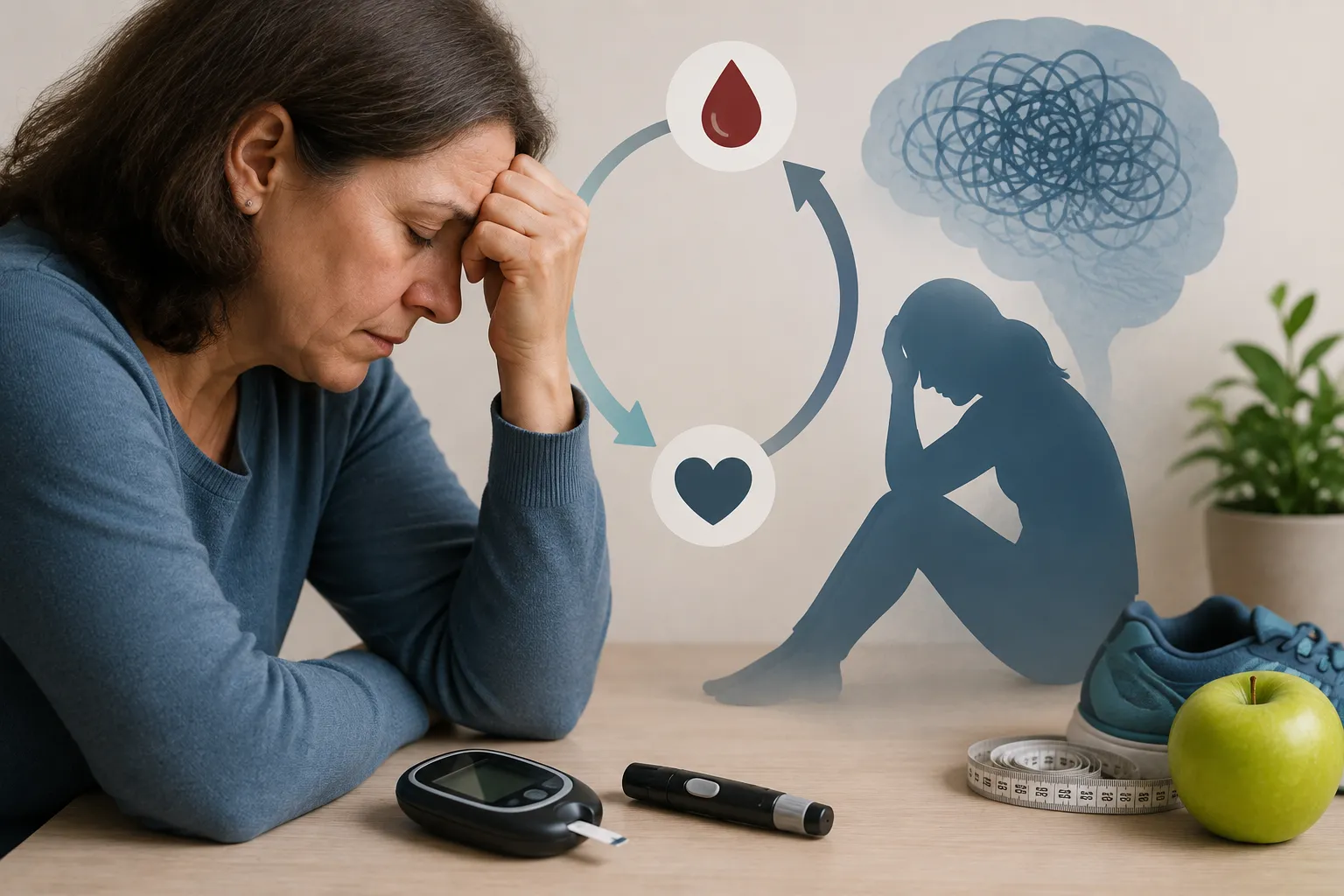

There are days when you are just tired. Tired of looking at the sensor, thinking about what you are going to eat, calculating carbohydrates, taking medication, exercising, interpreting a glucose that you don't understand or worrying about possible complications.
And the next day it's time to start again.
That's why I think it's important to talk about the relationship between diabetes and depression. Not to assume that living with diabetes inevitably leads to depression, because it does not, but because we know that both conditions appear together quite frequently.
According to the studies cited in the article, between 24% and 28% of people with type 2 diabetes have depression. Furthermore, the relationship appears to work in both directions: having type 2 diabetes is associated with an increased risk of depression, and depression is also associated with an increased risk of developing type 2 diabetes.
But there is something that seems especially important to me to differentiate.Not all emotional exhaustion related to diabetes is depression.
There is what we know as diabetes distress: that feeling of exhaustion, frustration, worry or saturation caused by having to manage an illness that practically never gives you vacations.
I think many of us who live with diabetes have experienced something similar at some point.Some days you are very aware of everything and other days you are simply tired of thinking about diabetes.And that matters because our emotional state can also end up affecting the control of the disease.
When a person is depressed it can be much more difficult to find the strength to exercise, eat properly, control their glucose, take medication or go to check-ups. Not necessarily because you don't want to take care of yourself, but because tasks that normally seem simple can become a huge effort.
Then a rather complicated circle may appear:
- I feel bad emotionally.
- It's harder for me to take care of my diabetes.
- My diabetes is getting worse.
- I'm worried I've lost control.
- I feel even worse.
- And start again.
But the relationship is not only psychological.
Research is also studying shared biological mechanisms between diabetes, obesity, metabolic syndrome and depression. These include chronic low-grade inflammation, hormonal alterations and prolonged activation of stress-related systems.
Cortisol, for example, can affect glucose metabolism and insulin sensitivity. Mechanisms related to inflammation and metabolic hormones such as leptin are also being investigated.
That is to say, we are facing a much more complex relationship than simply thinking that "a person is sad because they have diabetes."And precisely for this reason I think we should make it much more normal to talk about mental health in our diabetes consultations.When we go to the endocrinologist we talk about HbA1c, time in range, hypoglycemia, weight, diet, exercise or medication.
But how many times are we asked how we are emotionally handling all of this?
Perhaps we should listen with the same attention to a person who says "I can't handle diabetes anymore" as when they tell us that they are having too many hypoglycemias.Because both of these things can end up profoundly affecting your quality of life.
We should also try to eliminate blame.
In diabetes we constantly hear words like control, discipline, adherence, diet or exercise. When the results are not good it is very easy to think that we are doing something wrong.But behind poor glycemic control there can be many circumstances and, in some cases, there may also be a mental health problem that needs professional attention.
Asking for psychological help should not be considered separate from diabetes treatment.Taking care of our head is also part of taking care of our diabetes.And perhaps one of the questions we should hear most frequently in our reviews is an extremely simple one:
How are you managing your diabetes?
Have you ever gone through a stage where you felt completely exhausted from managing your diabetes?