
Hello
Those of you who follow a keto diet with type 1 diabetes wanted to know how your ketone levels are.
Hello
Those of you who follow a keto diet with type 1 diabetes wanted to know how your ketone levels are.
Hello @monicagf2576
It is a very interesting question, because in people with type 1 diabetes, ketones always raise many doubts.In a keto diet it is normal for nutritional ketones to appear (low or moderate levels), since the body uses fat as its main source of energy.This is not the same as ketoacidosis, which occurs when there is a lack of insulin and ketones become too high along with high blood sugar.
From what I have seen in other people with T1D who follow keto, it is common to find stable low or moderate ketones, especially if blood glucose levels are controlled and there is no insulin deficiency.Even so, many recommend measuring them from time to time, especially if glucose rises or if you feel unwell, to avoid scares.
We must also keep in mind that each body responds differently.There are people with type 1 diabetes who do very well by reducing carbohydrates a lot and others who prefer a more moderate approach because it is easier for them to manage.
Let's see if anyone on the forum who follows keto can share their experience and the levels of ketones they usually have, I'm sure that together we can clarify the topic a lot.
Diabetes Tipo 1 desde 1.998 | FreeStyle Libre 3 | Ypsomed mylife YpsoPump + CamAPS FX | Sin complicaciones. Miembro del equipo de moderación del foro.
Autor de Vivir con Diabetes: El poder de la comunidad online, parte de los ingresos se destinan a financiar el foro de diabetes y mantener la comunidad online activa.
Sígueme en Instagram
Hello!
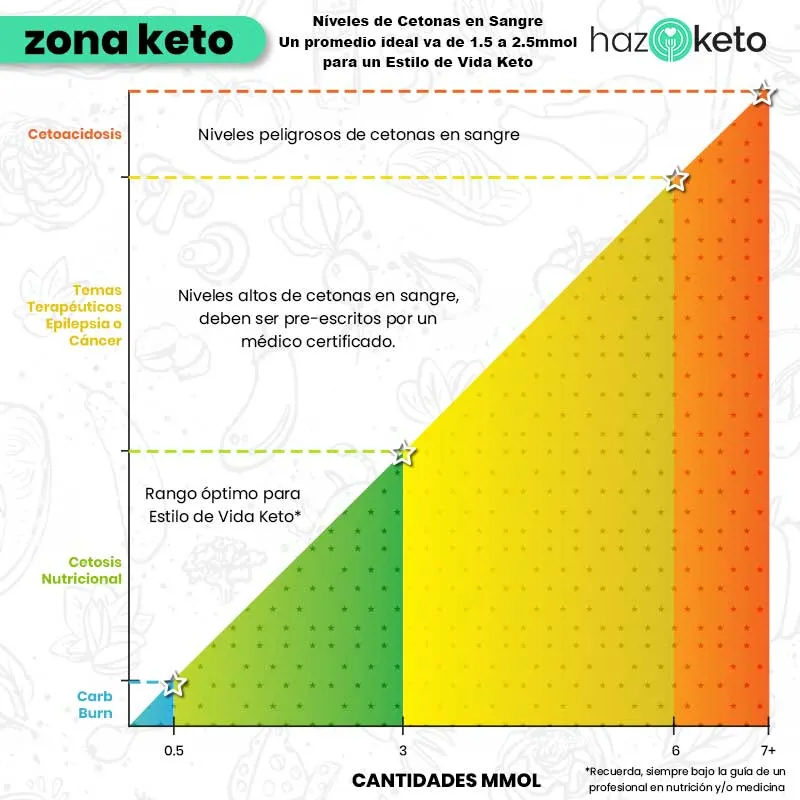
I have been following an adapted ketogenic diet for some months (Less fat and more protein than the "canonical" Keto, but maintaining very low levels of HdC).The approximate range of ketones in the blood, measured with the Freestyle Libre 2 strips, is 1.0 - 2.9 mmol/L, also depending a lot on the exercise I do and whether I fast or not (I usually eat 3 meals a day).
Despite consuming very few carbohydrates and doing sports, I always take basal in the morning and evening (Lantus) and in case of hyperglycemia, I correct it with Fiasp boluses.Ketoacidosis can occur when insulin levels are very low and hyperglycemia persists, but ketone bodiesBy themselves they are simply a valid alternative energy source to glucose.
37 años (30 años con Diabetes Tipo 1).
Low Carb Athlete (Finisher Utratrail/Utracycling events)
Solostar+Fiasp+Libre2Plus
Good morning, I brought up this topic because I have had LADA diabetes for three years until two months ago, controlled only with exercise and the keto diet.I've been using 11 units of Toujeo for two months now, and the truth is that my life is becoming easier.But the other day I was at an endocrine clinic for my son and he made the comment that the keto diet for type 2 diabetes was great, but that for type 1 it was dangerous, that you had to be careful with ketones.In the three years that I have been with another endocrinologist, he has never talked to me about this.Following that comment, I measured my blood ketones and it was 2.6.I was alarmed to see the levels they marked as adequate, less than 0.6.I have made an appointment with this endocrine, but I have it in April.I have also read that even if you have an adequate TIR or blood glucose, you can have euglycemic acidosis without knowing it, and this scares me, because I have an average blood glucose of 123, but high ketones.And it is true that throughout these years I have had episodes of vomiting and discomfort that I did not understand, and I maintain a terrible thirst that my endocrinologist told me was not normal and now I am wondering if it is not because I am in ketosis.I would like to know what the risk levels are for entering into acidosis, because the levels I have seen are from 3 on a test strip.And also, if you get sick, whether it is easily reversed or not and/or whether it leaves consequences.
My experience with the keto diet has been positive in terms of blood sugar, but the doctor told me that with type 1 diabetes, it is better to eat a minimum of 70 carbohydrates.In my case it is impossible to introduce that amount, otherwise my blood sugar would skyrocket, and it would no longer be keto, it would be lowcarb.I try to eat as much carbohydrate as I can, but I estimate that I will eat between 20-30 a day.
In my case, the experience with most endocrinologists has been quite bad.Fear of going off script, almost complete ignorance of other protocols, restrictions on sport...
Throughout these years, as soon as you propose a protocol that goes beyond what is generally accepted (which does not have to be ideal or valid for all people, ages or lifestyles), the most common reaction is to try to discourage you.There are things that do not make sense, such as for example that we continue to be prescribed 5 meals a day (more possibilities of altering blood glucose, more need for control, more insulin, more mental work...) or that the pillar of nutrition continues to be Carbohydrates (70 grams of Maria cookies at breakfast prescribed by an endocrinologist, as I have seen in some cases, seems like a crime to me, at a nutritional and diabetes care level)
The same thing happens with ketones, it seems that as soon as they are positive they must be interpreted as an imminent risk and nothing could be further from the truth.The danger is ketoacidosis, not ketones!
Among the symptoms you mention, it is very important to get used to drinking a lot more water (in addition to supplementing in some cases with electrolytes), because this type of diet causes us to lose a lot more water (as we lose glycogen, we lose water in large quantities. Thereforeeach gram of glycogen, the body retains up to4 grams of water, which is why you lose weight so quickly at first with this diet.Vomiting and other symptoms may fit what is known as "keto flu" eitherketo fluduring the first days, while the body gets used to obtaining energy mostly from fatty acids.
My recommendation is that you look for professionals (both nutritionists and endocrinologists) who are open to adapting the treatment to the patients and not the other way around as happens in most cases.Compare information, look for evidence, read studies... It is also true that the more information we have as patients, the more critical we can be and make better decisions regarding our life and treatment.
37 años (30 años con Diabetes Tipo 1).
Low Carb Athlete (Finisher Utratrail/Utracycling events)
Solostar+Fiasp+Libre2Plus
I take this opportunity to update the topic regarding eglycemic ketoacidosis and share a couple of interesting articles.It is a rare complication, but if you are using iSGLT2 (empagliflozin, canagliflozin, dapagliflozin and ertugliflozin) hExtreme caution should be taken since there is evidence that the use of these drugs together with low-carbohydrate diets can increase the incidence.
CASE ANALYSIS:
GENERAL INFO:
37 años (30 años con Diabetes Tipo 1).
Low Carb Athlete (Finisher Utratrail/Utracycling events)
Solostar+Fiasp+Libre2Plus
Here I also leave some topics where we discuss the Keto diet:
Numerous scientific studies show that ketogenic diets can help you lose weight and be beneficial against diabetes, ...
The fact is that the one that calls me the most is a so -cal...
Diabetes Tipo 1 desde 1.998 | FreeStyle Libre 3 | Ypsomed mylife YpsoPump + CamAPS FX | Sin complicaciones. Miembro del equipo de moderación del foro.
Autor de Vivir con Diabetes: El poder de la comunidad online, parte de los ingresos se destinan a financiar el foro de diabetes y mantener la comunidad online activa.
Sígueme en Instagram
Hello again,
I'm back with new news regarding my experience with ketones and the keto diet. On August 28, while working, I felt bad, very thirsty...and I measured my ketones. I was 3.5 so I got scared and went to the emergency room. They kept me riddled for 12 hours with an insulin and glucose infusion. They were looking for an infection, but there was none. I was dehydrated and had high ketones. Everything else good. They admitted me...and well, I'm going to save that experience so as not to drag it out.
The fact is that now I have to follow a low carb diet of over 50 grams of carbohydrates a day and it is being hell. From being 99 percent in the range and an average of 124, I am now on an average of 151 and range 80. Foods that previously did not raise my blood glucose, such as avocado, nuts...now two hours after eating they begin to rise and float for hours, and even if I correct them with rapid insulin, it is very difficult to lower them. Everything has changed, I am lost, scared...because on top of the 42 kilos I weighed, I have also lost more. It's consuming me.
There are times that if I take insulin while eating, I have to take glucose to avoid hiccups because it takes a while to rise, and other times the other way around. It's a total stress. I take into account the count, I weigh the food and at most I eat 25 grams of carbohydrates in a meal (on the day with the most) and it is always a catastrophe. I'm raising my basal rate as they told me, one at a time, from 11 I was at 14 and still nothing.
I don't know if you know how to go from keto to low carb more successfully. What foods and how to eat them, because of course if I were heavier it would be easier without adding fat to the meals, but I can't afford it.
I spend all day correcting and sticking to the sensor. I'm on sick leave and already very anxious. I would appreciate knowing if anyone has had this experience and how they did it.
Hello @Monica2576,
Based on what has happened to you, I think it is a good decision to abandon the keto diet and start a progressive increase in carbohydrates. 50 grams a day seems little to me if you want to gain weight, but if you have problems adjusting the doses quickly, it may be good to start with low amounts and increase them progressively, this way you reduce the impact of not getting the dose right.
I don't know if I have understood correctly what you are saying about basal. Changes in basal are not related to the response to food, but rather to the insulin needs that your body requires throughout the day (when you are not eating). If you see that you get an increase hours after eating, it is not necessarily that your basal body is lacking but it could be due to an excess of fats and proteins.
To balance my dose of Toujeo, what I do is if, for example, I go to sleep with a value of 100, I hope to wake up the next day with a value between 85 and 115 to assume that the dose is correct. If I rise above this range I consider increasing one unit, and if I am below, I lower one unit. To assess the effect of changing the basal rate with Toujeo, you must wait at least three days.
For meals, I understand that they will have given you an insulin regimen. If, for example, you eat 25 grams of carbohydrates and we assume that you need 2.5 units of rapid to metabolize them, you must inject that amount if you are, for example, in a range of 100 -120. If you are in the range of 80 -99 you go down half a unit, if you are between 121-140 you go up half a unit.
Waiting time is important to prevent blood glucose from rising quickly, so we must ensure that insulin is acting when we start eating. The time can be variable depending on each person, depending on the time of day, and depending on the injection area (for example, the leg is slower than the abdomen). It is best to see the change in trend on the meter to ensure that the insulin is acting and is the signal to start eating.If you are in the lower range (between 70 or 85) you can't play much and it is worth reducing the waiting time you are used to a little so as not to be out of range. If it is high, you can increase the time to ensure that the insulin is already lowering blood glucose.
If it is difficult for you to balance the doses, for example, try to always have the same breakfast, at least at the beginning so that you can have a reference for the ratio of carbohydrates and insulin. Prioritize whole foods and fiber so that the rise in glucose is more progressive.
To gain weight you have to achieve a caloric surplus (eat more calories than you expend). The body doesn't care if those calories come from carbohydrates, proteins or fats.If you include an excess of fat and protein in your meals, it will make management difficult, since it will cause digestion to be much slower, which leads to an initial drop because glucose takes longer to enter the blood and you have insulin acting, and a subsequent rise in glucose (3 hours later) when you no longer have active insulin left.
Luck!!
LADA 2022. Inicio insulina Abril 2025.
Toujeo, y Fiasp con NovoPen Echo Plus.
Dexcom One+
Glicosilada: 4.9

Choose your store and the book edition. Your purchase helps this forum continue to grow and support people living with diabetes, their families and friends.
💙 No ads. Just real support. Every book counts — it’s more than a purchase, it’s a gesture of solidarity that keeps this community alive.